Plastic vs steel jerry cans
Why Scepter’s MIL-spec HDPE replaced steel as the military standard — and where steel still fits
Most European units still buy steel jerry cans, largely out of habit. The U.S. and Canadian armed forces did not: Scepter’s Military Fuel Can (MFC) is standard issue to both, and it is HDPE, not steel. This page sets out what actually changes when you switch — and, honestly, the two cases where steel still has an edge.
Steel jerry can vs Scepter MFC
| Steel jerry can | Scepter MFC (HDPE) | |
|---|---|---|
| Empty weight | approx. 4.3 kg | approx. 2.3 kg |
| Corrosion | Rusts internally over time; rust can pass into the vehicle fuel system | Does not corrode |
| Construction | Welded seams, which can split as the can ages | One continuous moulding — no welds |
| Impact | Dents; a dented can rusts faster at the dent and loses integrity | Absorbs impact and returns to shape |
| Pressure build-up | No visible indication that pressure has built | Swells visibly — the crew can see it and vent the cap |
| If ruptured near fire | Metal failure disperses fragments | The most important advantage in dangerous situations - burns without fragmenting and exploding |
| Fuel marking | Paint or stencil | Colour-coded strap: yellow = diesel, red = petrol |
| Specification | Varies by manufacturer | MIL-C-53109 / CID A-A-59592A, UN/NATO qualified |
Weights are for the 20 L class. Scepter publishes the MFC as “rugged HDPE”, UN/NATO qualified and standard issue to the U.S. and Canadian Armed Forces.
What changes in the field
1. Roughly half the empty weight
A 20 L steel can weighs about 4.3 kg empty against about 2.3 kg for the MFC. On a vehicle carrying twelve cans that is around 24 kg of packaging removed before a single litre of fuel is loaded — payload that goes back to the mission.
2. No internal rust, so no contaminated fuel
Water vapour inside a steel can corrodes it from within. That rust travels with the fuel into the tank, where it clogs fuel lines and filters. HDPE does not corrode, so the fuel that goes in is the fuel that comes out — which matters most for equipment that sits in reserve and is expected to start.
3. No welds to fail
A steel can is welded; an ageing can can split along the weld. The MFC is moulded in one continuous process, so there is no seam to open.
4. Pressure you can see
In warm climates pressure builds inside any fuel container. A plastic can swells visibly, and the crew can release it by opening the cap. A steel can gives no outward sign, so the first indication is when the cap is opened.
5. Damage behaviour
Dropped or struck, a steel can dents — and a dent is both a weak point and a place that rusts faster. HDPE absorbs the impact. If a container does fail near fire, a plastic can burns; it does not disperse metal fragments.
6. Contents marked on the can
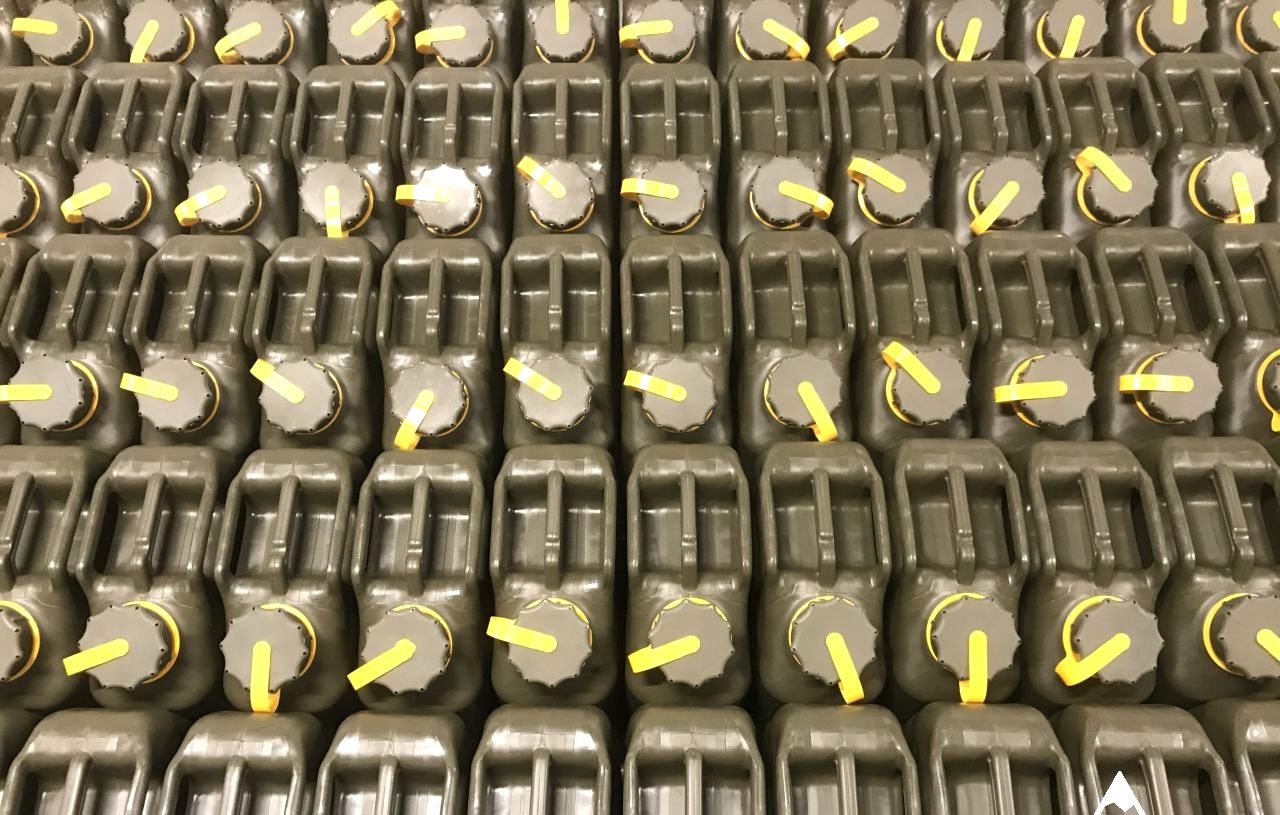
The MFC carries a coloured strap indicating contents — yellow for diesel, red for petrol. Every can we ship has a Viton seal under the cap and takes petrol, diesel or kerosene, so the strap records what you put in rather than limiting it. Two part numbers (12074, 12076) carry a strap in the can’s own colour, leaving the choice to the crew; further strap colours are available on request. This is a small thing that prevents an expensive mistake.
7. Emptied in under a minute
With the original 1 in. Scepter spout (P/N 04353), a full 20 L can empties in under a minute. Over a twelve-can refuel that is the difference between a halt and a pause — and it is done without a funnel, because the spout seals to the neck.
8. Fifteen years is a normal service life
With nothing to dent through and nothing to rust out, MFCs commonly stay in service fifteen years or more. Tenders usually compare unit price; the figure that decides the cost is price per year in service.
9. It floats
A built-in air chamber keeps a full can afloat if it goes into the water during a crossing, a beach landing or loading. A steel can sinks.
The video is not loaded until you press play. Pressing play loads it from YouTube.
Where steel still has an edge
Sustained direct flame. Steel holds its shape longer under prolonged direct heat. HDPE will burn. If your requirement includes sustained flame exposure, specify against it rather than assuming either material.
Very long static storage. For fuel held for long periods without rotation, vapour permeation and temperature cycling deserve consideration in any container choice. The MFC is specified for field use and rotation.
We would rather you know this before the tender than after. If either case applies to your requirement, tell us and we will say so.
Why plastic for water cans?
The comparison above is a fuel-can question — steel never had the same foothold in military water supply, but the same material logic carries over. Scepter’s Military Water Canister (MWC) has served the U.S. and Canadian forces since the 1960s and is specified under MIL-DTL-43613E. For the fuel-can side of the argument, see the full comparison table above.
| Metal water can | Scepter MWC (HDPE) | |
|---|---|---|
| Empty weight (20 L) | Approx. 4 kg in the classic steel-can pattern | It is lighter: 1.97 kg |
| Water contact | Metallic taste; internal coatings wear and chip | Food-grade HDPE (FDA 21 CFR) — no taste, no lining to fail |
| Corrosion | Steel rusts inside; rust ends up in the water | Does not corrode |
| Cleaning | Narrow neck — you clean what you can reach | Wide top opening — reach in by hand to scrub and inspect |
| Impact | Dents; seams can open | One continuous moulding — flexes and returns to shape |
| Buoyancy | Sinks | Floats, even when full |
Cleaning is the water-can question. Whatever stays inside — sediment, biofilm, the residue of the last fill — ends up in the next fill. A water can you cannot clean properly is a water can you cannot trust. The MWC’s wide opening takes a hand and a brush: you scrub it, you look inside, you know it is clean.
Questions procurement asks
Why did the U.S. and Canadian armed forces move from steel to plastic fuel cans?
The HDPE military can removed the failure modes of the steel can — internal rust contaminating fuel, welds splitting, dents becoming weak points — while cutting empty weight roughly in half. Scepter’s MFC is standard issue to both forces.
Are plastic jerry cans safe for petrol and diesel?
Containers specified for fuel are. The relevant question is not “plastic or metal” but which specification: the MFC is built to MIL-C-53109 / CID A-A-59592A and is UN/NATO qualified. General-purpose plastic containers are not comparable and should not be used for fuel.
What about static electricity when filling?
Standing the container on the ground while filling is correct practice for any fuel container, plastic or steel. It is a handling procedure, not a material property.
Will the can melt or burst in heat?
In warm conditions the can swells as pressure builds, which is visible and can be vented at the cap. That is a designed indication, not a failure. Sustained direct flame is a different case — see above.
What is MIL-C-53109?
The US/NATO military specification for fuel cans, alongside the commercial item description CID A-A-59592A. It is the specification the MFC is built to, and the one to quote in a tender.
Are NSN codes and datasheets available?
Yes, per SKU, on request. Send the part numbers and quantities in an RFQ and we will attach the documents your tender requires.
Switching from steel?
We hold the Scepter MFC range in European stock in Estonia and handle the import chain, so you buy EU-cleared from a local partner. Tell us your quantities and we will come back with pricing, lead time and compliance documents.
Request a Quote → See the full MFC range and part numbers →Official address
Tiigi 28Jüri alevik, Rae vald
75301, Harjumaa
Estonia
You are also welcome to send your inquiries to andreas@foxberg.ee or call +372 5111 420.